Noble County Ohio has 10 places on the National Register of Historic Places including 2 places of National significance and 1 place of Statewide significance. Significant places include SHENANDOAH Crash Sites, SHENANDOAH Crash Sites and Huffman Covered Bridge, Caldwell, Samuel, House and Danford, Samuel, Farm, Church and Cemetery.
Several famous people are associated with these Noble County historic places including Zachary Lansdowne, Abner Williams, Henry Young and Samuel Caldwell.
Some of the country's most noteable architects helped create the Noble County places including Mill & Summers, Tobias Shaw, Adolph Druiding, J.W. Yost and Abner Williams. Prominent architectural styles found in Noble Country are Greek Revival, Gothic and Queen Anne.
Historic Significance:
Event, Person
Historic Person:
Lansdowne,Zachary
Area of Significance:
Military, Transportation
Period of Significance:
1925-1949
Historic Function:
Agriculture/Subsistence, Domestic
Historic Sub-function:
Agricultural Fields, Single Dwelling
Current Function:
Agriculture/Subsistence, Recreation And Culture
Current Sub-function:
Agricultural Fields, Monument/Marker
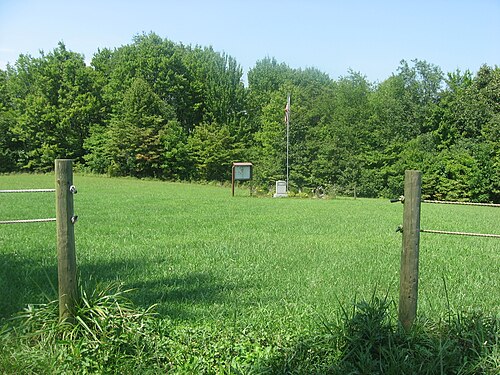
The USS Shenandoah Crash Sites in Noble County, Ohio, mark the final resting places of America's first American-built rigid airship, the USS Shenandoah (ZR-1). On September 3, 1925, during a promotional flight over the Midwest, the massive helium-filled dirigible encountered a violent squall line over southeast Ohio. The extreme turbulence tore the airship into three main sections, which crashed across several miles of rural Noble County. The forward bow section, carrying several surviving crew members, free-ballooned for nearly an hour before landing near Sharon, while the stern section and the detached control car crashed violently near Ava and Belle Valley, resulting in the deaths of 14 of the 43 crew members, including the airship's commander, Zachary Lansdowne. The disaster instantly became a national sensation, attracting tens of thousands of onlookers to the quiet hills of Noble County and sparking a frenzy of souvenir hunting that stripped the wreckage of many technical components.
Listed on the National Register of Historic Places under Criterion A, the Shenandoah crash sites are exceptionally significant in the history of military aviation, technology, and weather forecasting. The tragedy exposed critical vulnerabilities in rigid airship construction and the lack of adequate meteorological data for flight planning, directly leading to major improvements in structural engineering, the development of more robust weather-warning systems, and changes in operational protocols for the U.S. Navy. Additionally, the disaster ignited a fierce public controversy over the military's management of aviation, culminating in the historic court-martial of aviation pioneer Colonel Billy Mitchell, who accused military leaders of "almost treasonable administration." Today, the crash sites serve as sobering historic landmarks and memorials that capture a defining, transformative moment in the brief and turbulent era of rigid airship aviation.
Historic Significance:
Event, Person
Historic Person:
Lansdowne,Zachary
Area of Significance:
Military, Transportation
Period of Significance:
1925-1949
Historic Function:
Agriculture/Subsistence, Domestic
Historic Sub-function:
Agricultural Fields, Single Dwelling
Current Function:
Agriculture/Subsistence, Recreation And Culture
Current Sub-function:
Agricultural Fields, Monument/Marker
The USS Shenandoah Crash Sites in Noble County, Ohio, mark the final resting places of America's first American-built rigid airship, the USS Shenandoah (ZR-1). On September 3, 1925, during a promotional flight over the Midwest, the massive helium-filled dirigible encountered a violent squall line over southeast Ohio. The extreme turbulence tore the airship into three main sections, which crashed across several miles of rural Noble County. The forward bow section, carrying several surviving crew members, free-ballooned for nearly an hour before landing near Sharon, while the stern section and the detached control car crashed violently near Ava and Belle Valley, resulting in the deaths of 14 of the 43 crew members, including the airship's commander, Zachary Lansdowne. The disaster instantly became a national sensation, attracting tens of thousands of onlookers to the quiet hills of Noble County and sparking a frenzy of souvenir hunting that stripped the wreckage of many technical components.
Listed on the National Register of Historic Places under Criterion A, the Shenandoah crash sites are exceptionally significant in the history of military aviation, technology, and weather forecasting. The tragedy exposed critical vulnerabilities in rigid airship construction and the lack of adequate meteorological data for flight planning, directly leading to major improvements in structural engineering, the development of more robust weather-warning systems, and changes in operational protocols for the U.S. Navy. Additionally, the disaster ignited a fierce public controversy over the military's management of aviation, culminating in the historic court-martial of aviation pioneer Colonel Billy Mitchell, who accused military leaders of "almost treasonable administration." Today, the crash sites serve as sobering historic landmarks and memorials that capture a defining, transformative moment in the brief and turbulent era of rigid airship aviation.