Montgomery County Ohio (Page 4) has 19 places on the National Register of Historic Places including 2 places of National significance and 4 places of Statewide significance. Significant places include Wright Cycle Company--Wright and Wright Printing Offices, Wright Flyer III, Unit III, Dayton Project, Woodland Cemetery Gateway, Chapel And Office and Wright Cycle Company--Wright and Wright Printing Offices.
Prehistoric cultural affiliation(s) include Adena dating back to 999 BC.
Many famous people are associated with these Montgomery County historic places including Oroville & Wilbur Wright, Orville Wright, Edwin Forrest, Orville & Wilbur Wright and Dr. Jefferson A. Walters.
Some of the country's most noteable architects helped create the Montgomery County places including Wilbur Wright, Charles P. Garman, Oroville Wright, A. Strauch, Burns & Peters, John Rouzer, Charles Herby, Albert Pretzinger, C.S. Hughes and William Ear Russ. Prominent architectural styles found in Montgomery Country are Italianate, Late Victorian and Romanesque.
Historic Significance:
Architecture/Engineering, Person, Event
Architect, builder, or engineer:
Garman,Charles P., Et al.
Architectural Style:
Late Victorian
Historic Person:
Wright,Orville,et al.
Significant Year:
1897, 1895
Area of Significance:
Commerce, Transportation, Invention, Engineering, Communications
Period of Significance:
1875-1899
Historic Function:
Commerce/Trade
Historic Sub-function:
Specialty Store
Current Function:
Recreation And Culture
Current Sub-function:
Museum
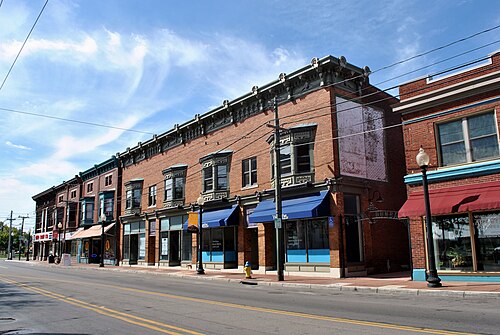
The Wright Cycle Company?Wright and Wright Printing Offices, located at 22 South Williams Street in Dayton, Ohio, is a highly significant two-story brick commercial building constructed in 1886. From 1895 to 1897, this building served as the fourth location of the Wright brothers' bicycle business and also housed their printing firm. Here, Orville and Wilbur Wright manufactured their own brands of bicycles, including the "Van Cleve" and "St. Clair," and operated their printing press, publishing local newspapers and commercial materials. It stands as the only surviving building still in its original location that housed a Wright bicycle shop, providing an invaluable physical link to the brothers' early commercial endeavors in Dayton.
Historically, the building is of national significance for its direct association with the birth of aviation. It was during their occupancy of this Williams Street facility that the Wright brothers first turned their serious attention to the problem of human flight, using the profits generated from their bicycle and printing enterprises to fund their initial aeronautical research. The mechanical skills, toolsets, and engineering principles-such as chain drives and aerodynamic balance-that they developed while designing and repairing bicycles in this shop directly informed the design and construction of their early gliders and the historic 1903 Wright Flyer. Designated a National Historic Landmark in 1990, the building now serves as a centerpiece of the Dayton Aviation Heritage National Historical Park, preserving the cradle of the Wrights' inventive genius.
Historic Significance:
Person, Architecture/Engineering, Event
Architect, builder, or engineer:
Wright,Oroville, Wright,Wilbur
Architectural Style:
Other
Historic Person:
Wright,Oroville & Wilbur
Significant Year:
1908, 1905
Area of Significance:
Transportation, Invention, Engineering
Period of Significance:
1900-1924
Historic Function:
Transportation
Historic Sub-function:
Air-Related
Current Function:
Recreation And Culture
Current Sub-function:
Museum
The Wright Flyer III, designated a National Historic Landmark and listed on the National Register of Historic Places, is internationally recognized as the world's first practical airplane. Designed and built by Wilbur and Orville Wright in 1905, this pioneering aircraft represents the ultimate culmination of the brothers' early aeronautical research and development. Unlike its predecessors-the famous 1903 flyer, which was highly unstable, and the 1904 flyer, which struggled with control-the Wright Flyer III featured a redesigned control system, a larger rudder, and elevators positioned further from the wings. These critical modifications allowed the brothers to achieve fully controlled, sustained flights at Huffman Prairie outside Dayton, Ohio, including banking, turning, circling, and flying figure-eights, thereby proving that powered flight was a viable, controllable, and practical means of transportation.
Following its historic trials in the autumn of 1905, which culminated in Wilbur's spectacular 39-minute flight covering more than 24 miles, the aircraft was disassembled. In the late 1940s, the Flyer III was meticulously restored to its 1905 configuration under the direct guidance and personal inspection of Orville Wright himself. Today, the aircraft is beautifully preserved and displayed as the centerpiece of the Wright Brothers Aviation Center at Carillon Historical Park in Dayton, Ohio. It holds the distinction of being the first airplane designated as a National Historic Landmark, serving as a premier monument to one of the greatest technological achievements in human history.