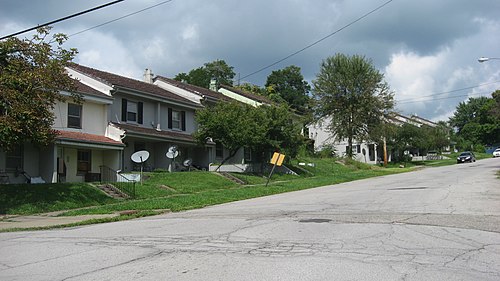
Mahoning County Ohio (Historic Districts) has 14 places on the National Register of Historic Places including 1 place of National significance and 2 places of Statewide significance. Significant places include Youngstown Sheet and Tube Company Housing, Mill Creek Park Historic District and South Main Street District, Alliance Clay Product Company and Arlington Avenue District.
Several famous people are associated with these Mahoning County historic places including Judge James B. Kennedy and George Wick.
Some of the country's most noteable architects helped create the Mahoning County places including Herding & Boyd, Brooke & Dyer et al., Barton E. Brooke, Dunn and Copper, Philadelphia Toboggan Co., Harton, T.M., Co., Charles H. Owsley and et al. Meade and Hamilton. Prominent architectural styles found in Mahoning Country are Colonial Revival, Italianate and Bungalow/Craftsman.
Historic Significance:
Architecture/Engineering
Architect, builder, or engineer:
Herding & Boyd
Architectural Style:
No Style Listed
Area of Significance:
Landscape Architecture, Engineering
Period of Significance:
1900-1924
Historic Function:
Domestic
Historic Sub-function:
Single Dwelling
Current Function:
Domestic
Current Sub-function:
Single Dwelling
The Youngstown Sheet and Tube Company Housing, located in Campbell (formerly East Youngstown), Ohio, stands as a highly significant monument to early twentieth-century corporate paternalism and industrial labor relations. Constructed between 1918 and 1920 in the wake of a violent 1916 steel strike, the housing complex was developed by the Youngstown Sheet and Tube Company to stabilize, control, and "Americanize" its rapidly growing, largely immigrant workforce. Designed to replace overcrowded and substandard tenements, the planned community offered workers modern, sanitary living conditions, which the company hoped would foster loyalty, reduce labor turnover, and curb unionization efforts. This neighborhood reflects the socio-economic dynamics of the Mahoning Valley steel boom, capturing a period when industrial giants actively shaped the civic and domestic lives of their employees to ensure uninterrupted productivity.
Architecturally, the housing complex is nationally significant as one of the earliest and most extensive experiments in mass-produced, precast concrete residential construction in the United States. Designed and built by the Unit Construction Company of St. Louis, the "Prefabs"-as they became locally known-consisted of multi-family, terrace-style dwellings constructed almost entirely of reinforced, precast concrete slabs. This innovative engineering method was selected for its durability, fireproofing, and ease of sanitation, presenting a highly modern, technological solution to the industrial housing crisis of the World War I era. Today, the Youngstown Sheet and Tube Company Housing remains a rare, surviving physical record of pioneering concrete construction technology and the pervasive influence of the steel industry on the built environment of the region.