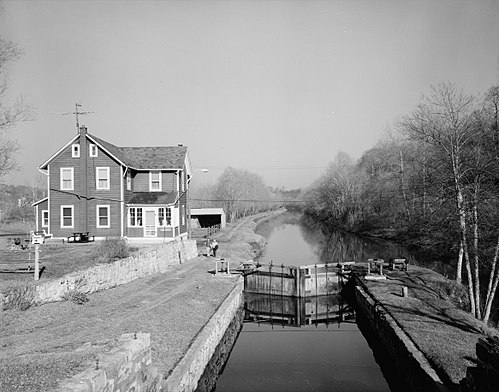
Northampton County Pennsylvania has 50 places on the National Register of Historic Places including 9 places of National significance and 10 places of Statewide significance. Significant places include Bethlehem Steel Lehigh Plant Mill #2 Annex, Central Bethlehem Historic District, Delaware Division of the Pennsylvania Canal, Gemeinhaus-Lewis David De Schweinitz Residence and Historic Moravian Bethlehem Historic District.
Many famous people are associated with these Northampton County historic places including John Valentine Haidt, Lewis David De Schweinitz, Robert Sayre, William Jacob Heller and George Taylor.
Some of the country's most noteable architects helped create the Northampton County places including Josiah White, Canvass White, Bethlehem Steel Corporation, Tobias Hirt, Carl Schulze, Herbert C. Dilliard, Jacob Stem, E.A. Douglas, Pasco Construction Co. and Charles Beckel. Prominent architectural styles found in Northampton Country are Late Victorian, Federal and Late 19th And 20th Century Revivals.
Historic Significance:
Architecture/Engineering, Event
Architect, builder, or engineer:
Bethlehem Steel Corporation
Architectural Style:
Other
Area of Significance:
Industry, Architecture
Period of Significance:
1950-1974, 1925-1949
Historic Function:
Industry/Processing/Extraction
Historic Sub-function:
Manufacturing Facility
Current Function:
Work In Progress
The Bethlehem Steel Lehigh Plant Mill #2 Annex, constructed between 1899 and 1900, is a premier monument to the United States' industrial golden age and a vital component of the sprawling Bethlehem Steel Corporation complex in Northampton County. Located in Bethlehem, Pennsylvania, this massive, multi-story industrial building is characterized by its heavy steel-frame construction and brick curtain walls, an architectural design engineered to support the immense weight and vibrations of heavy machinery. The Annex was built as an expansion to Machine Shop No. 2-which was reputedly the largest machine shop in the world at the time of its construction. Architecturally, the building reflects the functional aesthetic of late 19th-century heavy industrial design, utilizing large arched windows to maximize natural light for the workers inside.
Historically, the Mill #2 Annex is deeply significant for its role in both the American industrial revolution and the nation's military-industrial complex. Under the leadership of Charles M. Schwab, the Lehigh Plant became a powerhouse of global steel production and ordnance manufacturing. The Mill #2 Annex was specifically utilized for the precision machining of heavy forgings, giant naval gun barrels, and armor plating, making it instrumental to the modernization of the United States Navy during the Spanish-American War, World War I, and World War II. As a surviving structure of the Bethlehem Steel legacy, the Annex stands as a testament to the labor of thousands of workers, the technological innovations in metallurgy that shaped American skyscrapers, and the industrial might that propelled the United States into a global superpower.
Historic Significance:
Architecture/Engineering, Person, Event
Architect, builder, or engineer:
Unknown
Architectural Style:
Federal, Late Victorian
Historic Person:
Haidt,John Valentine
Area of Significance:
Art, Commerce, Education, Landscape Architecture, Engineering, Community Planning And Development, Industry, Performing Arts, Religion, Architecture
Period of Significance:
1800-1824, 1750-1799
Historic Function:
Commerce/Trade
Current Function:
Commerce/Trade
The Central Bethlehem Historic District, located in Bethlehem, Pennsylvania, is a site of preeminent national and international significance, representing the exceptionally well-preserved core of the communal settlement founded by the Moravian Church in 1741. Serving as the center of Moravian missionary, cultural, and industrial activity in North America, the district showcases a unique, planned community designed around the Moravian "General Economy" system. This communal social structure organized residents into "choirs" by age, gender, and marital status, which is physically manifested in the district's distinctive, German-Colonial limestone architecture. The district's extraordinary architectural and historical integrity culminated in its designation as a National Historic Landmark in 2012, and its subsequent inclusion as a UNESCO World Heritage Site in 2024, honoring its global contribution to Protestant communal planning and religious history.
Key contributing properties within the district highlight both the domestic life and the sophisticated industrial capabilities of the early Moravian settlers. Notable structures include the Gemeinhaus (1741), the oldest remaining building in Bethlehem, alongside the massive, multi-story Brethren's, Sisters', and Widows' Houses, and the monumental Central Moravian Church, completed in 1806. Along the Monocacy Creek, the district features a colonial industrial quarter, recognized as one of the earliest and most advanced industrial areas in the American colonies. This quarter includes the 1761 Tannery and the 1762 Waterworks, the latter of which is celebrated as the first pumped municipal water system in the United States. Together, these elements reflect the Moravians' remarkable synthesis of religious devotion, communal living, artistic expression, and technological innovation.
Historic Significance:
Event, Architecture/Engineering
Architect, builder, or engineer:
Unknown
Architectural Style:
No Style Listed
Area of Significance:
Engineering, Industry
Period of Significance:
1825-1849, 1800-1824, 1750-1799
Historic Function:
Industry/Processing/Extraction
Historic Sub-function:
Water Works
Current Function:
Recreation And Culture
Current Sub-function:
Museum
The Old Waterworks, located in Bethlehem's Colonial Industrial Quarter along the Monocacy Creek, holds immense historical significance as the site of the first pumped municipal water system in the American colonies. Originally constructed as a temporary wooden structure in 1754?1755 by the Danish Moravian millwright Hans Christopher Christiansen and replaced by the surviving stone building in 1762, the facility represented an extraordinary technological achievement for 18th-century America. Utilizing an undershot waterwheel to power a sophisticated triple-piston pump, the system successfully propelled fresh spring water through a network of hollowed hemlock logs up a 90-foot elevation to a central water tower, from which it was distributed to the Moravian community's communal buildings and residences.
Architecturally, the 1762 stone building is a beautifully preserved example of German colonial limestone construction, featuring segmental-arched windows, a red-clay tile gable roof, and robust masonry designed to withstand the vibrations of heavy machinery. Beyond its architectural appeal, the Old Waterworks is a monument to the Moravians' advanced urban planning, communal resourcefulness, and engineering ingenuity. Recognized as a National Historic Landmark in 1972 and designated an Historic Civil Engineering Landmark, the building remains a centerpiece of the Moravian Bethlehem UNESCO World Heritage site, symbolizing the dawn of public utility systems and early industrial heritage in the United States.











.jpg)