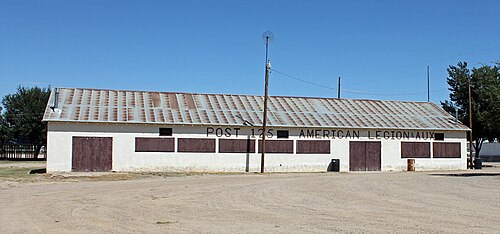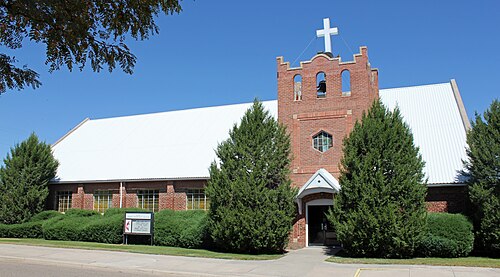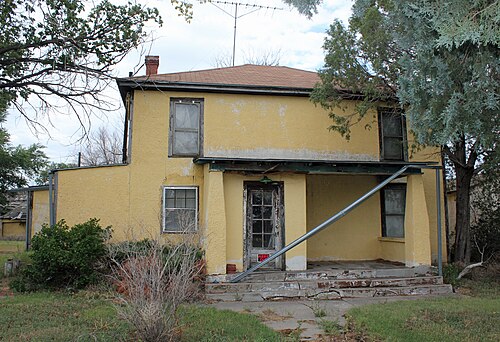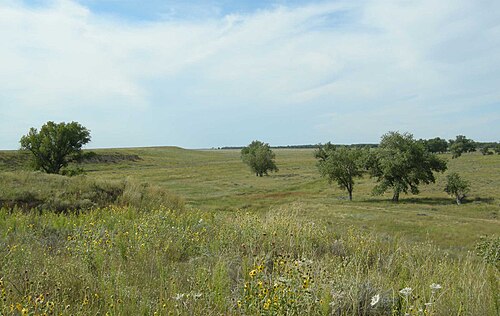
Kiowa County Colorado has 7 places on the National Register of Historic Places including 2 places of National significance. Significant places include Sand Creek Massacre Site and Sand Creek Massacre Site (Boundary Increase), American Legion Hall, Crow-Hightower House and Eads Community Church.
Some of the country's most noteable architects helped create the Kiowa County places including Elmer E. Nieman, William Stickney, Warren A Portrey and WPA. Prominent architectural styles found in Kiowa Country are Mission/Spanish Revival, Modern Movement and Tudor Revival.
Historic Significance:
Information Potential, Event
Area of Significance:
Military, Native American, Historic - Aboriginal
Cultural Affiliation:
Cheyenne, Arapaho
Period of Significance:
1850-1874
Historic Function:
Defense, Domestic, Other
Historic Sub-function:
Battle Site, Camp
Current Function:
Agriculture/Subsistence, Domestic, Landscape, Recreation And Culture, Transportation
Current Sub-function:
Agricultural Fields, Irrigation Facility, Monument/Marker, Natural Feature, Road-Related, Secondary Structure, Single Dwelling
The Sand Creek Massacre Site, located in Kiowa County, Colorado, marks the location of one of the most tragic and infamous events in the history of the American West. On November 29, 1864, a force of approximately 675 Colorado U.S. Volunteer Cavalry, commanded by Colonel John Chivington, launched a devastating, unprovoked attack on a peaceful village of Cheyenne and Arapaho Indians camped along Big Sandy Creek. Despite Chief Black Kettle raising both an American flag and a white flag of truce to signal their peaceful intentions under promised military protection, the soldiers slaughtered between 150 and 230 Native Americans. The vast majority of the victims were women, children, and the elderly, and the troops subsequently mutilated the bodies in an atrocity that shocked the nation and shattered any immediate hope for peaceful coexistence on the Great Plains.
The historical significance of the site extends far beyond the immediate horror of the event, as the massacre ignited a cycle of intense retaliatory warfare across the central plains and led to three separate federal investigations that heavily condemned Chivington's actions. Listed on the National Register of Historic Places in 2001 and subsequently authorized as a National Historic Site, this preserved landscape serves as a solemn monument to the victims and a sacred ground for the descendant Cheyenne and Arapaho tribes. It stands as a powerful and enduring symbol of the tragic consequences of westward expansion, broken federal treaties, and the ongoing process of national reckoning and historical healing.