Washington - San Juan County - Historic Districts
San Juan County Washington (Historic Districts) has 8 places on the National Register of Historic Places including 3 places of National significance. Significant places include American and English Camps, San Juan Island, Roche Harbor and San Juan Island National Historic Site, Camp Nor'Wester and Krumdiack Homestead.

Prehistoric cultural affiliation(s) include Samish and Kwakiuti dating back to 2999 BC.

Some of the country's most noteable architects helped create the San Juan County places including Theodore & Thomas Tharald, Paul Kirk and Friedrich Krumdiak. Prominent architectural styles found in San Juan Country are .


American and English Camps, San Juan Island (added 1966 - - #09000465)
San Juan Island , Friday Harbor
send us a photo to share
Historic Significance:
Event
Area of Significance:
Military
Period of Significance:
1850-1874
Owner:
Federal, Federal
Current Function:
Landscape
Current Sub-function:
Park
The American and English Camps on San Juan Island are of exceptional historical significance as the primary sites of the "Pig War" of 1859, a tense but bloodless boundary dispute between the United States and Great Britain. Following the Oregon Treaty of 1846, ambiguity regarding the water boundary through the San Juan Archipelago led both nations to claim the strategically located island group. Tension escalated into a full military standoff in June 1859 when an American settler shot a pig belonging to the British Hudson's Bay Company. In response, both nations dispatched military forces to the island: the U.S. Army established American Camp on the windswept southern peninsula, while the British Royal Marines constructed English Camp along the sheltered waters of Garrison Bay to the north. For twelve years, the two garrisons maintained a joint occupation, representing a unique period of peaceful coexistence, mutual hospitality, and social interaction between rival military forces while diplomats negotiated a resolution.

Today, the camps are preserved as part of the San Juan Island National Historical Park, protecting some of the nation's best-preserved structures from mid-19th-century military life. English Camp retains several of its original buildings, including a blockhouse, commissary, and barracks set against a formal English garden, while American Camp features surviving officers' quarters and historic redoubt earthworks. The site stands as a profound monument to international diplomacy, marking the successful resolution of the boundary dispute in 1872 through peaceful arbitration by Kaiser Wilhelm I of Germany, which permanently established the San Juan Islands as United States territory. The camps endure as a rare testament to how two global powers averted war through restraint, cooperation, and legal compromise.
Camp Nor'Wester (added 1997 - - #97000262)
Also known as Sperry Peninsula; The Henderson Camp
SE tip of Lopez Island, approx. .25 mi from Henderson Lake , Lopez Island
send us a photo to share
Historic Significance:
Information Potential, Event, Architecture/Engineering
Architect, builder, or engineer:
et al., Kirk, Paul
Architectural Style:
Other
Area of Significance:
Entertainment/Recreation, Native American, Exploration/Settlement, Prehistoric, Architecture
Cultural Affiliation:
Samish, Kwakiuti
Period of Significance:
500-999 BC, 499-0 BC, 499-0 AD, 1950-1974, 1925-1949, 1900-1924, 1875-1899, 1850-1874, 1749-1500 AD, 1000-500 AD, 1000-2999 BC, 1000 AD-999 BC
Owner:
Private
Historic Function:
Domestic
Historic Sub-function:
Camp
Current Function:
Vacant/Not In Use
Krumdiack Homestead (added 1993 - - #93000367)
Also known as Cook Property
N. coast, between Fishery Pt. and Pt. Hammond , Waldron Island
send us a photo to share
Historic Significance:
Architecture/Engineering, Event
Architect, builder, or engineer:
Krumdiak, Friedrich
Architectural Style:
Other
Area of Significance:
Exploration/Settlement, Architecture
Period of Significance:
1900-1924, 1875-1899
Owner:
Private
Historic Function:
Agriculture/Subsistence, Domestic
Historic Sub-function:
Agricultural Outbuildings, Single Dwelling
Current Function:
Agriculture/Subsistence, Domestic
Current Sub-function:
Agricultural Outbuildings, Single Dwelling
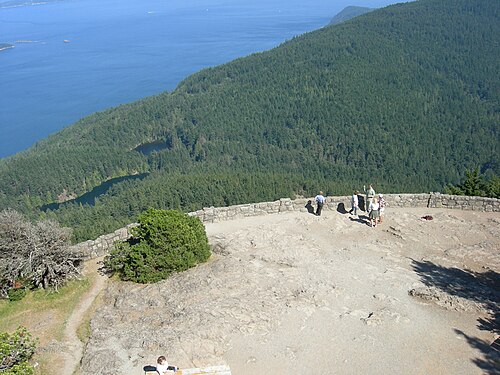
Moran State Park (added 2013 - - #12001140)
3572 Olga Rd., Olga
Jmabel, CC BY-SA 3.0, via Wikimedia Commons
Historic Significance:
Event, Architecture/Engineering, Person
Architectural Style:
Other
Historic Person:
Moran, Robert
Area of Significance:
Entertainment/Recreation, Architecture, Politics/Government
Period of Significance:
1925-1949, 1900-1924
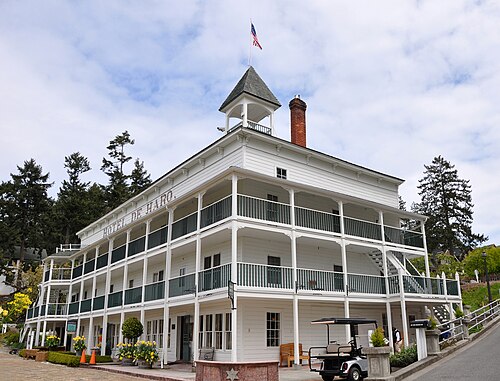
Roche Harbor (added 1977 - - #77001356)
Northern San Juan Island , San Juan Island
Finetooth, CC BY-SA 3.0, via Wikimedia Commons
Historic Significance:
Event, Architecture/Engineering
Architect, builder, or engineer:
Unknown
Architectural Style:
No Style Listed
Area of Significance:
Industry, Social History, Architecture
Period of Significance:
1900-1924, 1875-1899
Owner:
Private
Historic Function:
Commerce/Trade, Domestic
Historic Sub-function:
Business, Single Dwelling
Current Function:
Health Care
Current Sub-function:
Resort
The Roche Harbor Historic District, located on the northwest coast of San Juan Island, is historically significant as one of the most complete and influential company towns in the Pacific Northwest, representing the region's late 19th and early 20th-century industrial development. Established in 1886 by John S. McMillin and the Tacoma and Roche Harbor Lime Company, the site quickly grew into the largest lime-producing operation in the American West. The high-grade lime extracted from the local quarries and processed in the harbor's massive kilns was a critical material for mortar, plaster, and paper production, playing a vital role in rebuilding West Coast cities-most notably San Francisco after the 1906 earthquake and fire-and fueling the rapid expansion of Seattle and Tacoma.

The district preserves a remarkably intact assemblage of corporate, residential, and industrial architecture that reflects its heyday as a self-contained, paternalistic company town. Among its most prominent contributing resources is the historic Hotel de Haro, a sprawling wood-frame structure built around an 1860s Hudson's Bay Company post that hosted prominent guests such as President Theodore Roosevelt. Other key features include the remains of the monumental stone and brick lime kilns along the waterfront, a collection of uniform workers' cottages, executive residences, and the classical McMillin Mausoleum. Following the decline of the lime industry in the mid-20th century, the site was successfully adapted into a premier maritime resort, retaining its historic character and offering a vivid window into the industrial and maritime heritage of the Puget Sound.
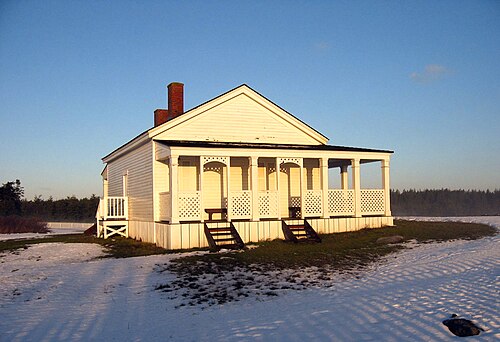
San Juan Island National Historic Site (added 1966 - - #66000369)
Also known as English Camp and American Camp;English and American Camps,Sa
Between Haro Strait and San Juan Channel , Friday Harbor
Jan Arkesteijn, Public domain, via Wikimedia Commons
Historic Significance:
Event
Area of Significance:
Politics/Government, Military
Period of Significance:
1850-1874, 1825-1849, 1800-1824
Owner:
Federal
Historic Function:
Agriculture/Subsistence, Defense, Domestic, Funerary
Historic Sub-function:
Camp, Cemetery, Military Facility
Current Function:
Landscape, Recreation And Culture
Current Sub-function:
Museum, Park
San Juan Island National Historic Site is nationally significant as the location of the "Pig War" of 1859, a tense but ultimately bloodless boundary dispute between the United States and Great Britain. Following the Oregon Treaty of 1846, ambiguous wording regarding the marine boundary through the San Juan Archipelago left ownership of the island unresolved, leading to joint occupation. The crisis peaked in June 1859 when an American settler shot a pig belonging to the British Hudson's Bay Company, prompting a military standoff. United States Infantry, initially commanded by Captain George E. Pickett, established a camp on the southern end of the island, while the British Royal Navy deployed warships and established a marine camp on the northern end. The standoff was resolved peacefully through international arbitration in 1872, when Kaiser Wilhelm I of Germany ruled in favor of the United States, establishing the final maritime border and marking the peaceful resolution of the last treaty-boundary dispute between the two nations in North America.

The historic site is divided into two distinct coastal units, American Camp and English Camp, which collectively preserve the cultural landscape of this unique period of joint military occupation. Located on the island's windy, grassy southern peninsula, American Camp retains the archaeological remains of the U.S. Army encampment, including officers' quarters and military earthworks. On the sheltered shores of Garrison Bay to the north, English Camp features exceptionally well-preserved structures erected by the British Royal Marines, including a blockhouse, commissary, barracks, and a formal garden. Together, these sites represent not only a critical chapter in 19th-century geopolitical history but also stand as a monument to international peace, illustrating how two powerful nations averted war through diplomacy and arbitration.
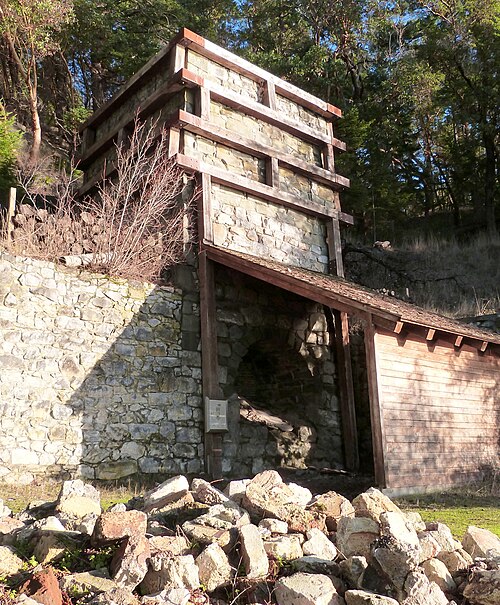
San Juan Lime Company--Cowell's (added 2007 - - #07000136)
Also known as Lime Kiln
1567 West Side Rd. N , Friday Harbor
Werewombat, CC BY-SA 3.0, via Wikimedia Commons
Historic Significance:
Information Potential, Event
Area of Significance:
Industry, Historic - Non-Aboriginal
Period of Significance:
1925-1949, 1900-1924, 1875-1899, 1850-1874
Owner:
Local, State
Historic Function:
Agriculture/Subsistence, Domestic, Industry/Processing/Extraction
Historic Sub-function:
Agricultural Outbuildings, Extractive Facility, Institutional Housing, Processing Site, Single Dwelling
Current Function:
Recreation And Culture, Vacant/Not In Use
Current Sub-function:
Outdoor Recreation
Tharald Homestead (added 2002 - - #01001473)
Also known as Ellis Farm
Hoffman Cove Rd. , Shaw Island
send us a photo to share
Historic Significance:
Event, Architecture/Engineering
Architect, builder, or engineer:
et.al., Tharald, Theodore & Thomas
Architectural Style:
No Style Listed
Area of Significance:
Architecture, Exploration/Settlement
Period of Significance:
1950-1974, 1925-1949, 1900-1924, 1875-1899
Owner:
Private
Historic Function:
Agriculture/Subsistence, Domestic
Historic Sub-function:
Agricultural Outbuildings, Single Dwelling
Current Function:
Agriculture/Subsistence, Domestic
Current Sub-function:
Agricultural Outbuildings, Single Dwelling
Return to Top
Select a Different Washington County (map)
Adams
Asotin
Benton
Chelan
Clallam
Clark
Columbia
Cowlitz
Douglas
Ferry
Franklin
Garfield
Grays Harbor
Island
Jefferson
King
Kitsap
Kittitas
Klickitat
Lewis
Lincoln
Mason
Pacific
Pend Oreille
Pierce
San Juan
Skagit
Skamania
Snohomish
Spokane
Stevens
Thurston
Wahkiakum
Walla Walla
Whatcom
Whitman
Yakima
Select a Different State (map)
Alabama
Alaska
Arizona
Arkansas
California
Colorado
Connecticut
Delaware
District Of Columbia
Florida
Georgia
Hawaii
Idaho
Illinois
Indiana
Iowa
Kansas
Kentucky
Louisiana
Maine
Maryland
Massachusetts
Michigan
Minnesota
Mississippi
Missouri
Montana
Nebraska
Nevada
New Hampshire
New Jersey
New Mexico
New York
North Carolina
North Dakota
Ohio
Oklahoma
Oregon
Pennsylvania
Rhode Island
South Carolina
South Dakota
Tennessee
Texas
Utah
Vermont
Virginia
Washington
West Virginia
Wisconsin
Wyoming
Return to Home Page