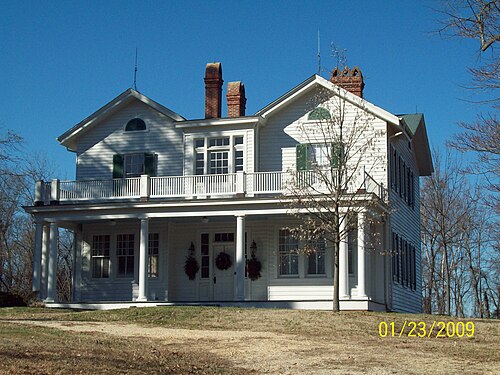
Calvert County Maryland has 22 places on the National Register of Historic Places including 5 places of National significance and 10 places of Statewide significance. Significant places include Cedar Hill, Drum Point Lighthouse, JEFFERSONIAN Gunboats NUMBER 137 and NUMBER 138 (Shipwreck), Maidstone and TENNISON, WM. B. (Chesapeake Bay Bugeye).
Prehistoric cultural affiliation(s) include Archaic, Woodland and Et Al. dating back to 8999 BC.
Several famous people are associated with these Calvert County historic places including Commodore Joshua Barney, Roger Brooke Taney and Charles Grahame.
Some of the country's most noteable architects helped create the Calvert County places including Johnathan Stricker, Frank Laird, B.P. Miles, William Price, Mr. Winston, Gibson & Company Lyons, J.B. Lusby, Gray, John B. and Sr.. Prominent architectural styles found in Calvert Country are Georgian, Colonial Revival and Gothic Revival.
Historic Significance:
Architecture/Engineering, Information Potential, Person, Event
Architect, builder, or engineer:
Price, William, Stricker, Johnathan
Architectural Style:
Other
Historic Person:
Barney, Commodore Joshua
Significant Year:
1807, 1808, 1814
Area of Significance:
Historic - Non-Aboriginal, Military, Maritime History, Architecture
Period of Significance:
1800-1824
Historic Function:
Defense, Transportation
Historic Sub-function:
Naval Facility, Water-Related
The Jeffersonian Gunboats No. 137 and No. 138 Shipwrecks, submerged in the waters of Calvert County, Maryland, are of exceptional historical significance as rare physical remnants of the United States' early naval defense strategy and the War of 1812. Constructed under President Thomas Jefferson's gunboat program, which favored a defensive, cost-effective coastal defense force of small, shallow-draft vessels over a large blue-water navy, these gunboats embody the political and military philosophies of the early Republic. During the War of 1812, these vessels were integrated into Commodore Joshua Barney's celebrated Chesapeake Bay Flotilla, which engaged in a series of daring skirmishes against the vastly superior British Royal Navy. In August 1814, as British forces advanced toward Washington, D.C., Barney ordered his flotilla scuttled in the Patuxent River to prevent the vessels from falling into enemy hands, securing their place in the dramatic climax of the Chesapeake Campaign.
From an archaeological perspective, the shipwrecks of Gunboats No. 137 and No. 138 serve as invaluable time capsules of early 19th-century American maritime technology. Preserved beneath the protective, anaerobic silt of the riverbed, the structural remains offer researchers rare, direct evidence of the design, construction techniques, and materials utilized in the Jeffersonian gunboat program-details that are largely absent from surviving historical blueprints. As highly intact underwater archaeological sites, these wrecks provide crucial insights into the daily lives of early American sailors and the tactical realities of the War of 1812, representing a vital resource for understanding the nation's naval heritage.