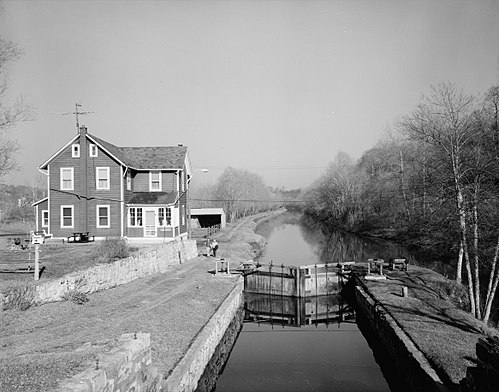
Northampton County Pennsylvania (Historic Districts) has 18 places on the National Register of Historic Places including 5 places of National significance and 4 places of Statewide significance. Significant places include Central Bethlehem Historic District, Delaware Division of the Pennsylvania Canal, Historic Moravian Bethlehem Historic District, Lehigh Canal: Eastern Section Glendon and Abbott Street Industrial Sites and Lehigh Canal; Allentown to Hopeville Section.
Several famous people are associated with these Northampton County historic places including John Valentine Haidt and Robert Sayre.
Some of the country's most noteable architects helped create the Northampton County places including Canvass White, Josiah White, Charles Beckel, Milton Bennett Medary, United States Housing Corporation, James Charles Sidney, William Michler, Speer Lumber Co., A.W. Leh and William Sebring. Prominent architectural styles found in Northampton Country are Late Victorian, Federal and Late 19th And 20th Century Revivals.
Historic Significance:
Architecture/Engineering, Person, Event
Architect, builder, or engineer:
Unknown
Architectural Style:
Federal, Late Victorian
Historic Person:
Haidt,John Valentine
Area of Significance:
Art, Commerce, Education, Landscape Architecture, Engineering, Community Planning And Development, Industry, Performing Arts, Religion, Architecture
Period of Significance:
1800-1824, 1750-1799
Historic Function:
Commerce/Trade
Current Function:
Commerce/Trade
The Central Bethlehem Historic District, located in Bethlehem, Pennsylvania, is a site of preeminent national and international significance, representing the exceptionally well-preserved core of the communal settlement founded by the Moravian Church in 1741. Serving as the center of Moravian missionary, cultural, and industrial activity in North America, the district showcases a unique, planned community designed around the Moravian "General Economy" system. This communal social structure organized residents into "choirs" by age, gender, and marital status, which is physically manifested in the district's distinctive, German-Colonial limestone architecture. The district's extraordinary architectural and historical integrity culminated in its designation as a National Historic Landmark in 2012, and its subsequent inclusion as a UNESCO World Heritage Site in 2024, honoring its global contribution to Protestant communal planning and religious history.
Key contributing properties within the district highlight both the domestic life and the sophisticated industrial capabilities of the early Moravian settlers. Notable structures include the Gemeinhaus (1741), the oldest remaining building in Bethlehem, alongside the massive, multi-story Brethren's, Sisters', and Widows' Houses, and the monumental Central Moravian Church, completed in 1806. Along the Monocacy Creek, the district features a colonial industrial quarter, recognized as one of the earliest and most advanced industrial areas in the American colonies. This quarter includes the 1761 Tannery and the 1762 Waterworks, the latter of which is celebrated as the first pumped municipal water system in the United States. Together, these elements reflect the Moravians' remarkable synthesis of religious devotion, communal living, artistic expression, and technological innovation.