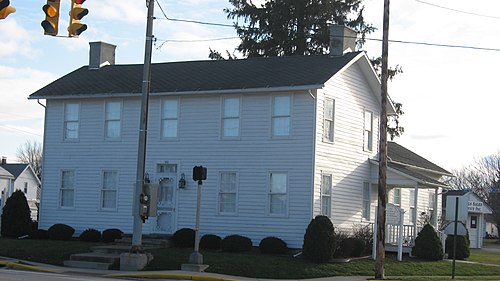
Sandusky County Ohio has 13 places on the National Register of Historic Places including 1 place of National significance and 3 places of Statewide significance. Significant places include Hayes, Rutherford B., House, Buckland, Ralph P., House, McPherson, Maj. Gen. James B., House and Mull Covered Bridge and Bartlett, Joseph and Rachel, House.
Many famous people are associated with these Sandusky County historic places including Rutherford B. Hayes, Maj. Gen. James B. McPherson, Frederick Fabing, Georg Cronenwett and Christopher C. Layman.
Some of the country's most noteable architects helped create the Sandusky County places including Sardis Birchard, Solomon Gould, Theodore Brockman, J.J. Johnson, John Carlton Johnson and Phillip C. Overmeyer. Prominent architectural styles found in Sandusky Country are Greek Revival, Italianate and Federal.
Historic Significance:
Person
Historic Person:
Hayes,Rutherford B.
Significant Year:
1893, 1873
Area of Significance:
Law, Politics/Government, Military, Social History
Period of Significance:
1875-1899, 1850-1874
Historic Function:
Domestic, Funerary
Historic Sub-function:
Cemetery, Single Dwelling
Current Function:
Education, Recreation And Culture
Current Sub-function:
Library, Museum
Spiegel Grove, the Rutherford B. Hayes House and Estate, is historically significant as the cherished home of the 19th President of the United States, Rutherford B. Hayes. Located in Fremont, Sandusky County, Ohio, the estate was initially developed by Hayes's uncle, Sardis Birchard, who began construction on the brick mansion in 1859. Hayes inherited the property and moved there in 1873, later expanding the residence into a sprawling 31-room Victorian mansion to accommodate his large family and extensive library. The home served as Hayes's sanctuary during his turbulent presidency (1877?1881) and became his permanent residence during his active post-presidential years, where he dedicated his time to humanitarian efforts, prison reform, and advocacy for universal education. The surrounding 25-acre wooded estate remains a beautifully preserved reflection of Hayes's personal interest in landscaping and forestry.
Beyond its association with the life of President Hayes, the estate is of monumental importance to American archival history as the site of the nation's first presidential library. Established in 1916, the Rutherford B. Hayes Presidential Library & Museum was built to house the President's personal collection of more than 12,000 volumes and his extensive personal papers, setting a lasting precedent for the preservation of executive branch records. The peaceful, park-like grounds also serve as the final resting place for both President Hayes and First Lady Lucy Webb Hayes, whose tombs are located on the property. Designated a National Historic Landmark in 1964 and listed on the National Register of Historic Places in 1966, Spiegel Grove stands as an enduring monument to the Civil War general, governor, and president who shaped late-nineteenth-century America.