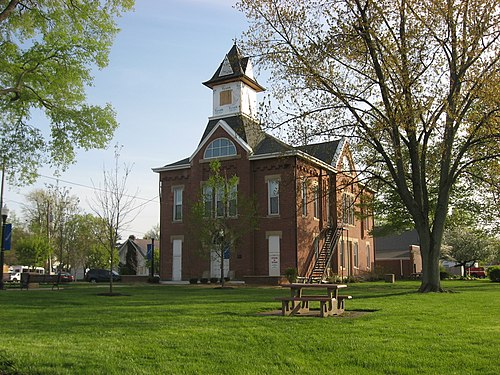
Licking County Ohio has 50 places on the National Register of Historic Places including 2 places of National significance and 11 places of Statewide significance. Significant places include Newark Earthworks, Oakwood, Alligator Effigy Mound, Avery-Hunter House and Bancroft, A. A., House.
Prehistoric cultural affiliation(s) include Hopewell, Adena, Woodland and Paleo-Indian dating back to 10999 BC.
Several famous people are associated with these Licking County historic places including Mead,William Henry,II, Henry Fleek and Carl L. Mead.
Some of the country's most noteable architects helped create the Licking County places including A.J. Downing, A.J. Davis, Wallace Carpenter, Joseph Evans, H.E. Myer, Benjamin Morgan, Frazier & Sheets Miller, Frank Packard, William Condit and Louis Sullivan. Prominent architectural styles found in Licking Country are Italianate, Gothic Revival and Queen Anne.
Historic Significance:
Information Potential
Area of Significance:
Prehistoric
Cultural Affiliation:
Hopewell
Period of Significance:
499-0 BC, 499-0 AD
Historic Function:
Funerary, Religion
Historic Sub-function:
Ceremonial Site, Graves/Burials
Current Function:
Landscape, Recreation And Culture
Current Sub-function:
Museum, Outdoor Recreation, Park
The Newark Earthworks, designated a National Historic Landmark in 1964 and listed on the National Register of Historic Places in 1966, represents the largest set of geometric earthen enclosures in the world. Constructed by the Hopewell culture between 100 BCE and 500 CE, this monumental complex originally spanned over 3,000 acres in present-day Licking County, Ohio. The site is comprised of incredibly precise geometric designs, including the Great Circle Earthworks, the Octagon Earthworks, and the Wright Earthworks, all built using hand-carried soil. These massive earthen walls, standing several feet high, define monumental spaces that served as ceremonial centers, social gathering places, and sacred landscapes for indigenous populations who traveled vast distances to gather here.
Beyond their architectural grandeur, the Newark Earthworks demonstrate an advanced ancient understanding of geometry and astronomy. The Octagon Earthworks, in particular, are precisely aligned with the complex 18.6-year lunar cycle, tracking the northernmost and southernmost risings and settings of the moon with remarkable accuracy. This celestial alignment suggests the site functioned as a grand observatory and a place of pilgrimage where people gathered to mark significant cosmic events. Today, the Newark Earthworks are recognized not only for their outstanding national significance but also as a UNESCO World Heritage Site, celebrated globally as a masterpiece of human creative genius and a testament to the sophisticated engineering of the ancient Hopewell people.
Historic Significance:
Architecture/Engineering
Architect, builder, or engineer:
Davis,A.J., Downing,A.J.
Architectural Style:
Gothic Revival
Area of Significance:
Architecture
Period of Significance:
1850-1874, 1825-1849
Historic Function:
Agriculture/Subsistence, Domestic
Historic Sub-function:
Single Dwelling
Current Function:
Domestic
Current Sub-function:
Multiple Dwelling
Oakwood, located at 345 North Hudson Street in Newark, Ohio, is historically significant as one of Licking County's finest and most intact examples of Gothic Revival residential architecture. Constructed circa 1849, the mansion epitomizes the "picturesque" movement popularized in mid-19th-century America by influential landscape gardener and architect Andrew Jackson Downing. The home features classic hallmarks of the Gothic Revival style, including steeply pitched gables decorated with intricate, hand-carved bargeboards (gingerbread trim), prominent lancet (pointed-arch) windows, and a romantic, asymmetrical massing that integrates the structure with its natural surroundings. Its design reflects a shift away from the rigid symmetry of earlier Greek Revival architecture toward a more whimsical, medieval-inspired aesthetic that captured the romantic spirit of the antebellum era.
Beyond its architectural distinction, Oakwood is highly significant for its association with the mid-19th-century development of Newark as a prosperous canal and railway hub. Built during a period of rapid economic expansion fueled by the Ohio and Erie Canal, the estate was constructed for a prominent local citizen on what was then the suburban edge of the city. The property stands as a physical representation of the wealth, taste, and social aspirations of Newark's emerging merchant and professional class during this golden age of growth. Listed on the National Register of Historic Places in 1980, Oakwood remains a vital local landmark, preserved to document both the evolution of romantic American residential design and the historic prosperity of Licking County.