Crawford County Ohio has 27 places on the National Register of Historic Places including 2 places of National significance and 2 places of Statewide significance. Significant places include Brownella Cottage and Grace Episcopal Church and Rectory, Picking, D., And Company, Big Four Depot and Howard, Adam, House and Beer, Judge Thomas, House.
Many famous people are associated with these Crawford County historic places including Lee Robert, Bishop William Montgomery Brown, Adam Howard, Col. William Crawford, Judge Thomas Beer and Asa Hosford.
Some of the country's most noteable architects helped create the Crawford County places including unknown, Homer Longstreth, Vern Redding, George Ross, Charles Fulton, R.C. Taylor, Roehr Interior Wood Trim Co., Frank L. Packard, Bauer,Minich, & Emmer and Asa Hosford. Prominent architectural styles found in Crawford Country are Queen Anne, Italianate and Gothic Revival.
Historic Significance:
Person, Architecture/Engineering
Architect, builder, or engineer:
unknown
Architectural Style:
Gothic Revival, Queen Anne
Historic Person:
Brown,Bishop William Montgomery
Significant Year:
1887, 1893, 1866
Area of Significance:
Architecture, Philosophy, Religion
Period of Significance:
1925-1949, 1900-1924, 1875-1899, 1850-1874
Historic Function:
Domestic, Religion
Historic Sub-function:
Church Related Residence, Religious Structure, Secondary Structure, Single Dwelling
Current Function:
Religion, Vacant/Not In Use
Current Sub-function:
Church Related Residence, Religious Structure
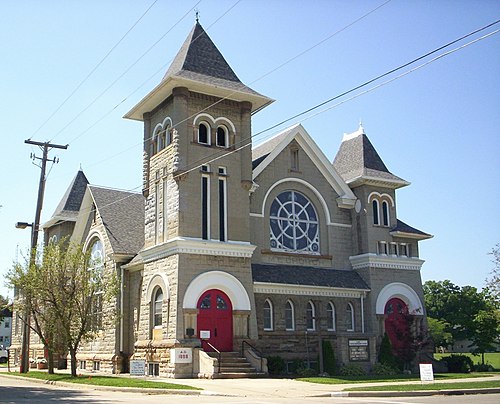
Located in Galion, Crawford County, Ohio, the Brownella Cottage and Grace Episcopal Church and Rectory historic district stands as a remarkably preserved late-nineteenth-century ecclesiastical and residential complex. The centerpiece of the district is Brownella Cottage, a striking Queen Anne-style brick mansion completed in 1887 that features ornate woodwork, stained glass, and a distinctive circular tower. Directly adjacent is the Grace Episcopal Church, an elegant Gothic Revival structure built in 1875 from local sandstone, characterized by its pointed-arch windows and steep gabled roof, alongside its accompanying rectory. Together, these buildings represent some of the finest examples of Victorian and Gothic architecture in Crawford County, reflecting the religious development and civic pride of the Galion community during its industrial boom era.
Beyond its architectural merit, the complex holds national historical significance for its close association with Bishop William Montgomery Brown, a prominent and highly controversial figure in American religious history. After serving as the Episcopal Bishop of Arkansas, Brown retired to Galion, where his theological views evolved dramatically toward Darwinism, socialism, and communism. It was inside Brownella Cottage that he penned his provocative 1920 book, Communism and Christianism, which prompted the Episcopal Church to try him for heresy in 1924-the first such trial held by the denomination since the Reformation-resulting in his deposition in 1925. Preserved today by the Galion Historical Society, the well-maintained property serves as a physical monument to Brown's intellectual legacy and the broader early-twentieth-century debates between religious orthodoxy and modern political ideologies.
Historic Significance:
Event
Area of Significance:
Industry
Period of Significance:
1850-1874
Historic Function:
Commerce/Trade, Industry/Processing/Extraction
Historic Sub-function:
Manufacturing Facility, Specialty Store
Current Function:
Industry/Processing/Extraction
Current Sub-function:
Manufacturing Facility
Established in 1874 by Daniel Picking, D. Picking and Company in Bucyrus, Crawford County, Ohio, stands as a remarkable monument to late 19th-century American industrial craftsmanship. Located in a modest, two-story brick commercial structure, the facility was custom-built to house the specialized manufacture of hand-hammered copper ware. Throughout the late nineteenth and twentieth centuries, the company served as a vital local enterprise and a cornerstone of Bucyrus's commercial district, producing high-quality copper kettles, measuring vessels, and agricultural wares that found markets both locally and nationwide.
The historical significance of D. Picking and Company lies in its status as one of the very last traditional, hand-hammered copper kettle factories in the United States. Utilizing original 19th-century tools, wooden mallets, cast-iron stakes, and belt-driven machinery, the shop preserved rare, pre-industrial metalsmithing techniques long after automated manufacturing became the global norm. Beyond utilitarian domestic and agricultural items, the company gained national renown for fabricating professional-grade copper tympani (kettledrums) for major orchestras. Listed on the National Register of Historic Places in 1974, the site represents an extraordinary, living link to the golden age of American coppersmithing, preserving both the physical workspace and the intangible heritage of an all-but-lost trade.











.jpg)


.jpg)
