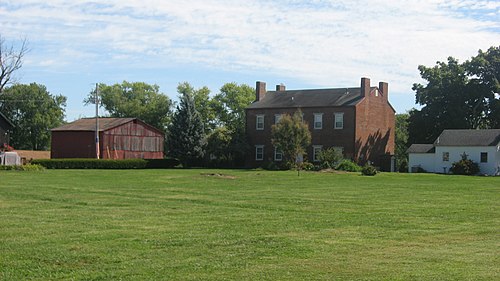
Clark County Indiana has 18 places on the National Register of Historic Places including 1 place of National significance and 4 places of Statewide significance. Significant places include Old Clarksville Site, Grisamore House, Howard Home, Ohio Falls Car and Locomotive Company Historic District and Old Jeffersonville Historic District dating back to 1000.
Several famous people are associated with these Clark County historic places including George Rogers Clark and Prof. Wm. Wesley Borden.
Some of the country's most noteable architects helped create the Clark County places including Arthur Loomis, Drach & Thomas, Benjamin Ferguson, unknown, John Work, Cleveland, Cincinnati and Chicago & St.. Prominent architectural styles found in Clark Country are Federal, Late Victorian and Bungalow/Craftsman.
Historic Significance:
Information Potential, Person
Historic Person:
Clark,George Rogers
Area of Significance:
Politics/Government, Historic - Non-Aboriginal, Transportation, Military
Cultural Affiliation:
Not Available
Period of Significance:
1800-1824, 1750-1799
Historic Function:
Domestic, Industry/Processing/Extraction
Historic Sub-function:
Manufacturing Facility, Single Dwelling
Current Function:
Agriculture/Subsistence, Domestic
Current Sub-function:
Agricultural Fields, Single Dwelling
The Old Clarksville Site, situated along the northern banks of the Falls of the Ohio in Clark County, Indiana, holds immense historical significance as the first authorized American settlement in the Northwest Territory. Established in 1783, the townsite was platted within the 150,000-acre Clark Grant, which was awarded by the state of Virginia to General George Rogers Clark and his regiment as compensation for their military service during the American Revolutionary War. George Rogers Clark himself lived at the site in a log cabin overlooking the falls during his later years. Furthermore, the site served as a pivotal launching pad for western exploration in October 1803, Meriwether Lewis met William Clark (George's younger brother) at this location, uniting the co-leaders of the Lewis and Clark Expedition and assembling the "Corps of Discovery" before departing down the Ohio River.
Beyond its prominent role in early American frontier history, the Old Clarksville Site possesses profound archaeological significance, encompassing a rich multi-component record of human habitation spanning thousands of years. Excavations and surveys have revealed dense prehistoric deposits beneath the historic 18th-century settlement layers, including significant Late Archaic shell middens and Middle Woodland cultural materials. These archaeological resources provide vital insights into the subsistence, technology, and migratory patterns of Native American populations who utilized the strategic falls region long before European contact. Listed on the National Register of Historic Places in 1974, the site remains a monumental landmark where Native American prehistory, Revolutionary War legacy, and the dawn of American westward expansion converge.