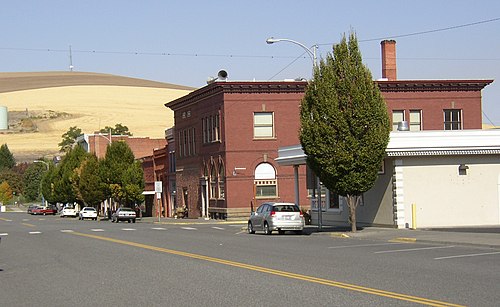
Washington - Walla Walla County - Historic Districts
Walla Walla County Washington (Historic Districts) has 4 places on the National Register of Historic Places including 1 place of National significance and 2 places of Statewide significance. Significant places include Fort Walla Walla Historic District, Lower Snake River Archaeological District and Windust Caves Archaeological District, Waitsburg Historic District.

Prehistoric cultural affiliation(s) include Cayuse and Windust Phase dating back to 8999 BC. Prominent architectural styles found in Walla Walla Country are Second Empire.

Fort Walla Walla Historic District (added 1974 - - #74001985)
Also known as Veteran's Administration Hospital
77 Wainwright Dr. , Walla Walla
JoJan, Public domain, via Wikimedia Commons
Historic Significance:
Event, Information Potential
Area of Significance:
Historic - Non-Aboriginal, Military
Cultural Affiliation:
American
Period of Significance:
1900-1924, 1875-1899, 1850-1874
Owner:
Local, Federal
Historic Function:
Defense, Funerary
Historic Sub-function:
Cemetery, Military Facility
Current Function:
Funerary, Health Care
Current Sub-function:
Cemetery, Hospital
Established in 1856 by Lieutenant Colonel Edward Steptoe, Fort Walla Walla played a pivotal role in the military history of the Pacific Northwest during the volatile Indian Wars of the mid-to-late 19th century. Positioned strategically to secure the Oregon Trail and assert federal control over the Inland Empire, the fort served as a major U.S. Army outpost during key regional conflicts, including the Yakima and Nez Perce wars. Originally constructed as a temporary stockade, it evolved into a permanent cavalry post by the late 1870s. The historic district preserves a remarkably intact collection of late-19th-century military architecture, including the 1858 commander's quarters-believed to be the oldest continuously occupied military residence in the state-alongside officer's row, barracks, and parade grounds that reflect the daily life and strategic operations of the frontier military.

Following its deactivation as an active military post in 1910, the site transitioned into a vital medical resource for veterans, reflecting the nation's changing priorities after World War I. In 1921, the property was transferred to the Bureau of War Risk Insurance, which quickly evolved into the Veterans Administration (VA). This transition led to the adaptation of historic military structures and the construction of new Colonial Revival-style hospital facilities to serve injured servicemen. Today, the Fort Walla Walla Historic District stands as a dual testament to frontier military history and the evolution of federal veterans' healthcare, preserved through the active VA Medical Center and the adjacent Fort Walla Walla Museum.
Lower Snake River Archaeological District (added 1984 - - #84000471)
Address Restricted , Burbank
Jon Roanhaus, CC BY-SA 4.0, via Wikimedia Commons
Historic Significance:
Information Potential
Area of Significance:
Historic - Aboriginal, Prehistoric
Cultural Affiliation:
Cayuse
Period of Significance:
1749-1500 AD, 1499-1000 AD, 1000-2999 BC, 1000 AD-999 BC
Owner:
Federal
Historic Function:
Domestic, Funerary
Historic Sub-function:
Graves/Burials, Single Dwelling
Current Function:
Government, Landscape
Waitsburg Historic District (added 1978 - - #78002784)
Main St. , Waitsburg
Williamborg, CC BY-SA 3.0, via Wikimedia Commons
Historic Significance:
Event, Architecture/Engineering
Architect, builder, or engineer:
Unknown
Architectural Style:
No Style Listed
Area of Significance:
Exploration/Settlement, Agriculture, Architecture
Period of Significance:
1925-1949, 1900-1924, 1875-1899
Owner:
Private, Local
Historic Function:
Commerce/Trade, Industry/Processing/Extraction
Historic Sub-function:
Financial Institution, Manufacturing Facility
Current Function:
Commerce/Trade, Domestic, Government, Industry/Processing/Extraction
Current Sub-function:
Business, City Hall, Manufacturing Facility, Multiple Dwelling
Windust Caves Archaeological District (added 1984 - - #84000479)
Address Restricted , Windust
Jon Roanhaus, CC BY-SA 4.0, via Wikimedia Commons
Historic Significance:
Information Potential
Area of Significance:
Prehistoric, Historic - Aboriginal
Cultural Affiliation:
Windust Phase
Period of Significance:
7000-8999 BC, 5000-6999 BC, 3000-4999 BC, 1900-1750 AD, 1749-1500 AD, 1499-1000 AD, 1000-2999 BC, 1000 AD-999 BC
Owner:
Federal
Historic Function:
Domestic
Historic Sub-function:
Camp
Current Function:
Government, Landscape
Return to Top
Select a Different Washington County (map)
Adams
Asotin
Benton
Chelan
Clallam
Clark
Columbia
Cowlitz
Douglas
Ferry
Franklin
Garfield
Grays Harbor
Island
Jefferson
King
Kitsap
Kittitas
Klickitat
Lewis
Lincoln
Mason
Pacific
Pend Oreille
Pierce
San Juan
Skagit
Skamania
Snohomish
Spokane
Stevens
Thurston
Wahkiakum
Walla Walla
Whatcom
Whitman
Yakima
Select a Different State (map)
Alabama
Alaska
Arizona
Arkansas
California
Colorado
Connecticut
Delaware
District Of Columbia
Florida
Georgia
Hawaii
Idaho
Illinois
Indiana
Iowa
Kansas
Kentucky
Louisiana
Maine
Maryland
Massachusetts
Michigan
Minnesota
Mississippi
Missouri
Montana
Nebraska
Nevada
New Hampshire
New Jersey
New Mexico
New York
North Carolina
North Dakota
Ohio
Oklahoma
Oregon
Pennsylvania
Rhode Island
South Carolina
South Dakota
Tennessee
Texas
Utah
Vermont
Virginia
Washington
West Virginia
Wisconsin
Wyoming
Return to Home Page