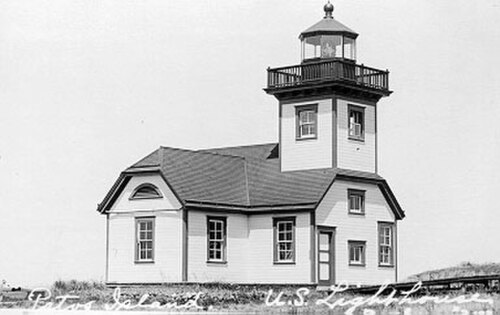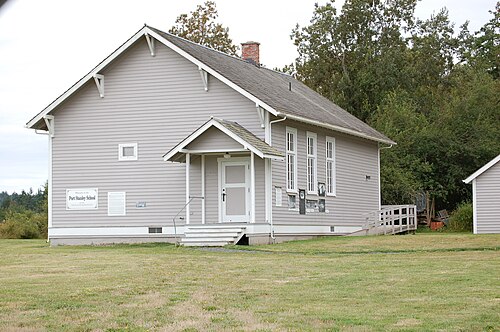
San Juan County Washington has 22 places on the National Register of Historic Places including 4 places of National significance and 2 places of Statewide significance. Significant places include American and English Camps, San Juan Island, Roche Harbor, San Juan Island National Historic Site, San Juan Island, Lime Kiln Light Station and Patos Island Light Station.
Prehistoric cultural affiliation(s) include Samish and Kwakiuti dating back to 2999 BC.
The famous person Robert Moran is associated with one of more of the San Juan County historic places.
Some of the country's most noteable architects helped create the San Juan County places including Robert Moran, Edwin Von Bogart, Gray, Sidney, R.S., W.E. Sutherland, Viereck family, Michael S. Donohue, Friedrich Krumdiak, Paul Kirk, Lee Noderer and Potter & Merrill. Prominent architectural styles found in San Juan Country are Bungalow/Craftsman, Greek Revival and Early Commercial.
Historic Significance:
Event
Area of Significance:
Military
Period of Significance:
1850-1874
Current Function:
Landscape
Current Sub-function:
Park
The American and English Camps on San Juan Island are of exceptional historical significance as the primary sites of the "Pig War" of 1859, a tense but bloodless boundary dispute between the United States and Great Britain. Following the Oregon Treaty of 1846, ambiguity regarding the water boundary through the San Juan Archipelago led both nations to claim the strategically located island group. Tension escalated into a full military standoff in June 1859 when an American settler shot a pig belonging to the British Hudson's Bay Company. In response, both nations dispatched military forces to the island: the U.S. Army established American Camp on the windswept southern peninsula, while the British Royal Marines constructed English Camp along the sheltered waters of Garrison Bay to the north. For twelve years, the two garrisons maintained a joint occupation, representing a unique period of peaceful coexistence, mutual hospitality, and social interaction between rival military forces while diplomats negotiated a resolution.
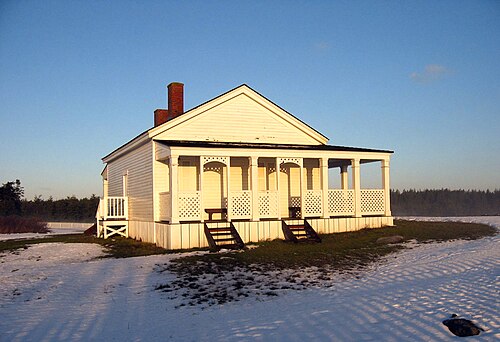
Today, the camps are preserved as part of the San Juan Island National Historical Park, protecting some of the nation's best-preserved structures from mid-19th-century military life. English Camp retains several of its original buildings, including a blockhouse, commissary, and barracks set against a formal English garden, while American Camp features surviving officers' quarters and historic redoubt earthworks. The site stands as a profound monument to international diplomacy, marking the successful resolution of the boundary dispute in 1872 through peaceful arbitration by Kaiser Wilhelm I of Germany, which permanently established the San Juan Islands as United States territory. The camps endure as a rare testament to how two global powers averted war through restraint, cooperation, and legal compromise.
Historic Significance:
Event, Architecture/Engineering
Architect, builder, or engineer:
Unknown
Architectural Style:
No Style Listed
Area of Significance:
Industry, Social History, Architecture
Period of Significance:
1900-1924, 1875-1899
Historic Function:
Commerce/Trade, Domestic
Historic Sub-function:
Business, Single Dwelling
Current Function:
Health Care
Current Sub-function:
Resort
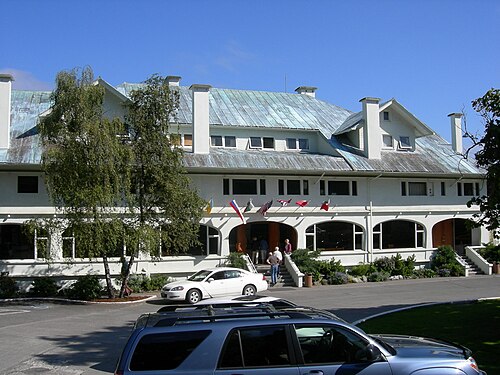
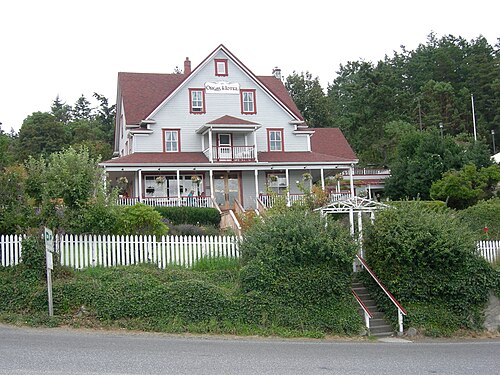
The Roche Harbor Historic District, located on the northwest coast of San Juan Island, is historically significant as one of the most complete and influential company towns in the Pacific Northwest, representing the region's late 19th and early 20th-century industrial development. Established in 1886 by John S. McMillin and the Tacoma and Roche Harbor Lime Company, the site quickly grew into the largest lime-producing operation in the American West. The high-grade lime extracted from the local quarries and processed in the harbor's massive kilns was a critical material for mortar, plaster, and paper production, playing a vital role in rebuilding West Coast cities-most notably San Francisco after the 1906 earthquake and fire-and fueling the rapid expansion of Seattle and Tacoma.
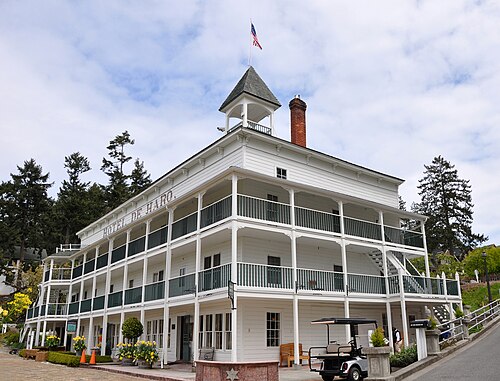
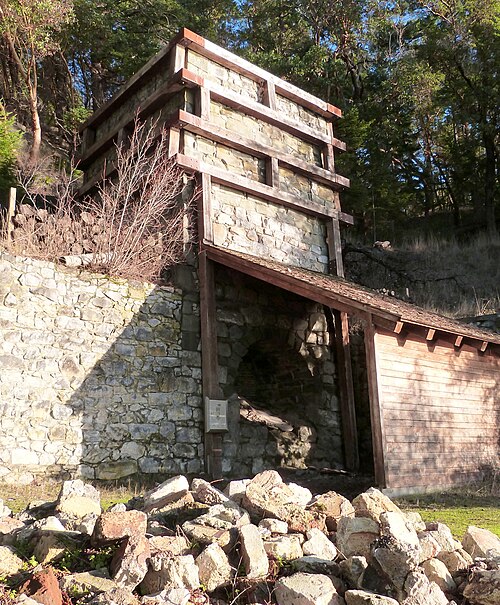
The district preserves a remarkably intact assemblage of corporate, residential, and industrial architecture that reflects its heyday as a self-contained, paternalistic company town. Among its most prominent contributing resources is the historic Hotel de Haro, a sprawling wood-frame structure built around an 1860s Hudson's Bay Company post that hosted prominent guests such as President Theodore Roosevelt. Other key features include the remains of the monumental stone and brick lime kilns along the waterfront, a collection of uniform workers' cottages, executive residences, and the classical McMillin Mausoleum. Following the decline of the lime industry in the mid-20th century, the site was successfully adapted into a premier maritime resort, retaining its historic character and offering a vivid window into the industrial and maritime heritage of the Puget Sound.
Historic Significance:
Event
Area of Significance:
Politics/Government, Military
Period of Significance:
1850-1874, 1825-1849, 1800-1824
Historic Function:
Agriculture/Subsistence, Defense, Domestic, Funerary
Historic Sub-function:
Camp, Cemetery, Military Facility
Current Function:
Landscape, Recreation And Culture
Current Sub-function:
Museum, Park
San Juan Island National Historic Site is nationally significant as the location of the "Pig War" of 1859, a tense but ultimately bloodless boundary dispute between the United States and Great Britain. Following the Oregon Treaty of 1846, ambiguous wording regarding the marine boundary through the San Juan Archipelago left ownership of the island unresolved, leading to joint occupation. The crisis peaked in June 1859 when an American settler shot a pig belonging to the British Hudson's Bay Company, prompting a military standoff. United States Infantry, initially commanded by Captain George E. Pickett, established a camp on the southern end of the island, while the British Royal Navy deployed warships and established a marine camp on the northern end. The standoff was resolved peacefully through international arbitration in 1872, when Kaiser Wilhelm I of Germany ruled in favor of the United States, establishing the final maritime border and marking the peaceful resolution of the last treaty-boundary dispute between the two nations in North America.
The historic site is divided into two distinct coastal units, American Camp and English Camp, which collectively preserve the cultural landscape of this unique period of joint military occupation. Located on the island's windy, grassy southern peninsula, American Camp retains the archaeological remains of the U.S. Army encampment, including officers' quarters and military earthworks. On the sheltered shores of Garrison Bay to the north, English Camp features exceptionally well-preserved structures erected by the British Royal Marines, including a blockhouse, commissary, barracks, and a formal garden. Together, these sites represent not only a critical chapter in 19th-century geopolitical history but also stand as a monument to international peace, illustrating how two powerful nations averted war through diplomacy and arbitration.
Historic Significance:
Architecture/Engineering
Architect, builder, or engineer:
Unknown
Architectural Style:
No Style Listed
Area of Significance:
Engineering
Period of Significance:
1900-1924
Historic Function:
Transportation
Historic Sub-function:
Water-Related
Current Function:
Transportation
Current Sub-function:
Water-Related
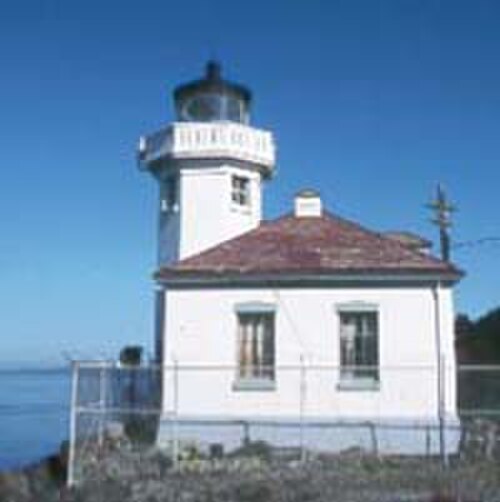
The Lime Kiln Light Station, established on the rocky western coast of San Juan Island, holds significant historical prominence as a vital aid to maritime navigation along the Haro Strait. Serving as a crucial international shipping channel between Washington state and Vancouver Island, British Columbia, the strait presented treacherous currents and heavy fog that posed constant hazards to vessels hauling regional resources like timber, coal, and locally quarried lime. First lit in 1914 as a modest beacon and expanded with a permanent station in 1919, the facility dramatically improved the safety of Pacific Northwest commerce during a period of rapid industrial growth. As one of the last major lighthouse stations constructed in Washington by the U.S. Lighthouse Service, it underscores the federal government's efforts to secure and facilitate maritime trade in the Puget Sound region.
Architecturally, the Lime Kiln Light Station stands as an exceptionally well-preserved example of early twentieth-century industrial and residential maritime design. The centerpiece of the property is the 38-foot octagonal reinforced concrete tower, which rises from a rectangular fog-signal building and is capped by a cast-iron lantern room. The surrounding complex retains its historic integrity, featuring two Craftsman-style keeper's duplexes, a garage, and support structures that reflect the standardized, utilitarian, yet aesthetically pleasing designs favored by the Lighthouse Service during this era. Automated in 1962 and later incorporated into Lime Kiln Point State Park, the station remains an active aid to navigation and a prominent cultural landmark illustrating the transition from manned lightkeeping to automated modern maritime technology.