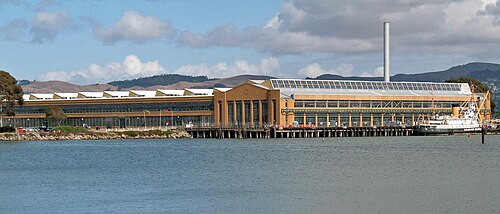
Contra Costa County California (Historic Districts) has 15 places on the National Register of Historic Places including 3 places of National significance and 6 places of Statewide significance. Significant places include Atchison Village Defense Housing Project, Cal. 4171-x, East Brother Island Light Station, Richmond Shipyard Number Three, Black Diamond Mines and Ford Motor Company Assembly Plant.
Some of the country's most noteable architects helped create the Contra Costa County places including Andrew T. Hass, Mory Wortman, Carl I. Warnecke, Unkown, Anor Larson, Albert Kahn, William S. & Son Mosser, Rider & Connor, Edward A. Hoffman and Havens & Topeke. Prominent architectural styles found in Contra Costa Country are Italianate, Queen Anne and Beaux Arts.
Historic Significance:
Event, Architecture/Engineering
Architect, builder, or engineer:
Wortman, Mory, Larson, Anor
Architectural Style:
Other, Moderne
Area of Significance:
Maritime History, Engineering, Military
Period of Significance:
1925-1949
Historic Function:
Defense, Industry/Processing/Extraction, Transportation
Historic Sub-function:
Manufacturing Facility, Naval Facility, Water-Related
Current Function:
Industry/Processing/Extraction, Transportation
Current Sub-function:
Manufacturing Facility, Water-Related
Henry J. Kaiser didn't know anything about building ships when he started. But by 1941, his crews in Richmond were churning them out faster than anyone thought possible. Shipyard Number Three stands out. It is the only one of Kaiser's four Richmond yards that survived the post-war wrecking ball. Instead of sliding ships down greasy wooden slipways, workers here built them in five massive concrete basins. They just flooded the basins and floated the hulls out. It was a massive industrial shift. Today, you can still see the giant Whirley cranes towering over the water. They look like prehistoric beasts. These cranes hoisted prefabricated steel sections weighing up to 90 tons, which welders then fused together in record time.
The yard didn't just build the SS Red Oak Victory and dozens of other vessels. It completely remade American society. Kaiser recruited anyone who could hold a welding torch. This meant thousands of women-the famous "Rosies"-and Black workers fleeing the Jim Crow South. Richmond's population skyrocketed. It went from 23,000 to over 100,000 in just three years. Kaiser had to build housing, set up 24-hour childcare centers, and organize a prepaid medical plan for his workers. That little medical plan actually grew into Kaiser Permanente. So, the site isn't just rust. It represents the birthplace of modern industrial healthcare and a crucible of civil rights.